Apple's HALO humanoid handles unseen rooms using simulated training data
Apple researchers got a Unitree G1 to finish 91% of 360 real-world tasks in unmapped rooms, learning mostly from generated motion rather than teleoperation.
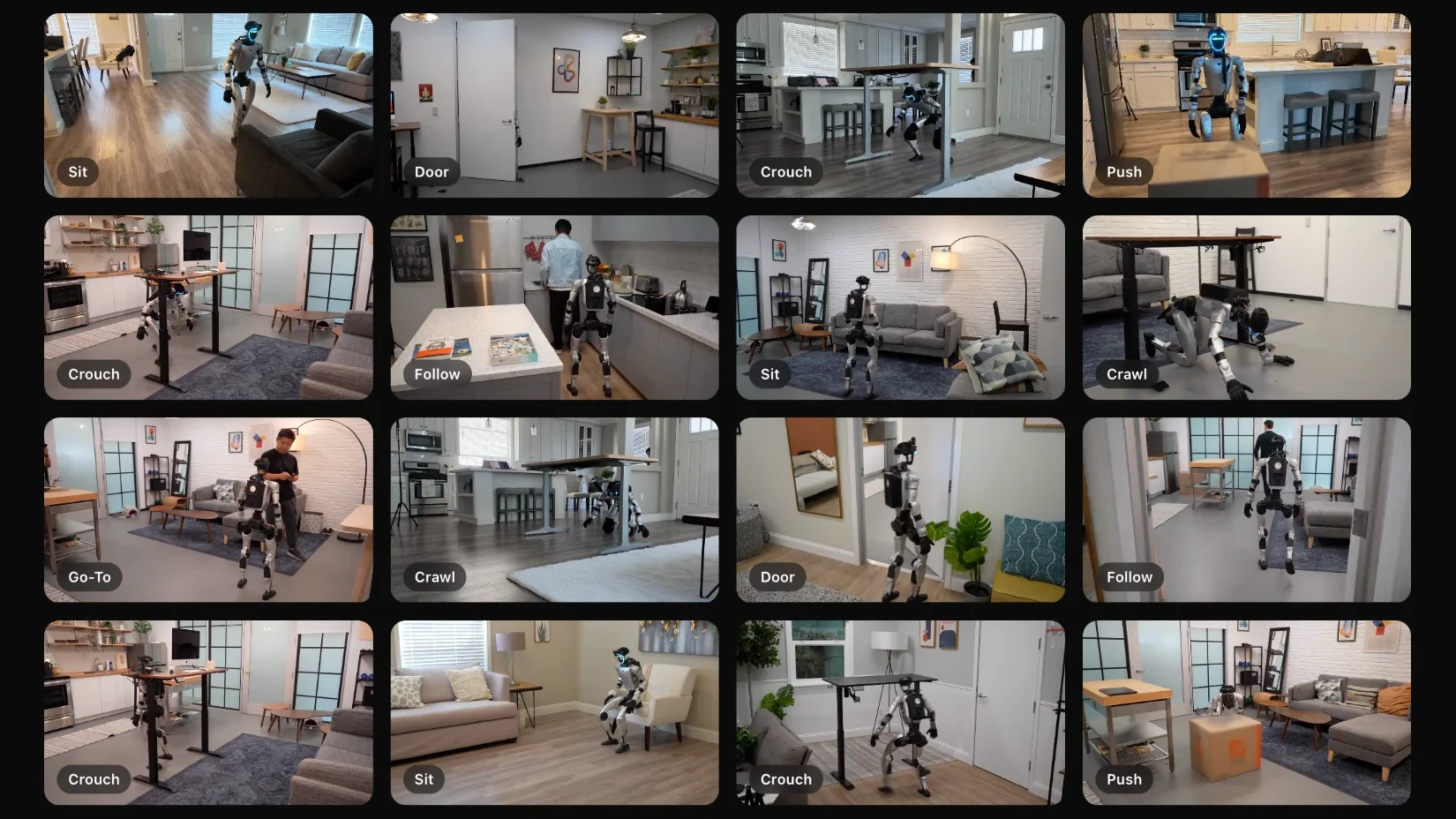
Apple researchers have built a system called HALO that lets a Unitree G1 humanoid move through rooms it has not seen before. It can head to an object, take a seat, duck under a table or shove a box. In 360 single-task trials across six real environments, the robot succeeded 91% of the time. No teleoperation data was used.
The motion planner learned from roughly 300 hours of generated movement, placed in 1,000 synthetic rooms and rendered in Isaac Sim. Three models share the work on the robot: a vision-language model splits requests into steps, a diffusion-based planner sketches five seconds of body motion, and a reinforcement-learning tracker drives the 29 joints. A Mac mini on the robot's back handles the first two, and the G1's own Jetson runs the tracker. The paper appeared on arXiv on November 4, and the code is on GitHub.
Chaining tasks proved harder, with a 70% average over three sequences. One sequence, crouching then walking to a box and pushing it, worked only half the time.
Why it matters
HALO suggests that generated data can replace hours of human operation for teaching robots to read a room. Still, the paper offers no head-to-head comparison with other published systems, none of the six skills involves hands, and each new skill needs a person to write prompts and keyframes. Apple has also not listed trained model weights or the dataset for download. Watch for whether those are released and whether recovery behaviours improve the chained results.