Beijing startup LiberAI trains a robot model on human video and reaches 36% zero-shot success
LiberAI's new Liber-0 model learns from human video and glove recordings, and completed 36% of 60 unseen tasks in 600 trials without task-specific robot demonstrations.
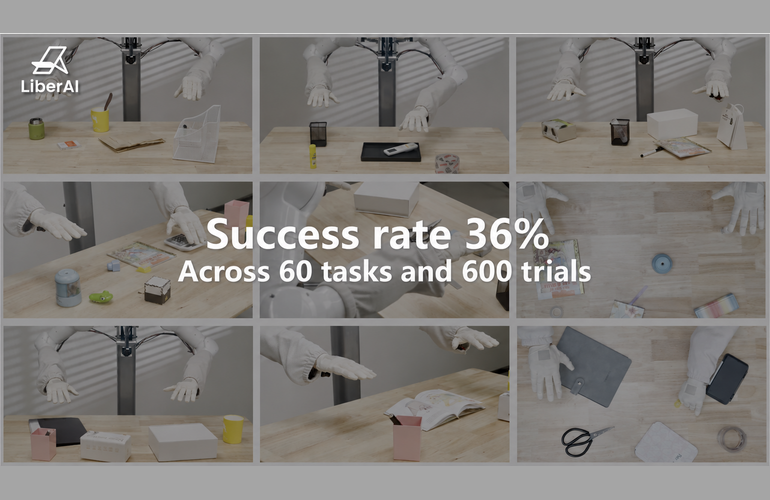
Beijing startup LiberAI has presented Liber-0, a robot model trained on over 2.2 million hours of human activity. It predicts upcoming video frames and robot actions together, so it can learn from plain video as well as from recordings that include measured hand motion.
In a test of 60 tasks suggested by GPT-6, run over 600 trials, Liber-0 succeeded 36.0% of the time without robot demonstrations made for those tasks. Simple pick-and-place jobs reached 63.5%, other manipulation 34.0%, and hard multi-step tasks only 10.5%. The company notes that the model's earlier training still included some robot data.
In a separate experiment, a policy trained on a quarter of the robot demonstrations plus all the glove recordings scored 75.6 on a progress scale, against 72.8 for one using every robot demonstration. Glove data is gathered without a robot on site, which could cut collection costs.
Why it matters
Collecting robot demonstrations is slow and expensive, so learning from human activity could speed up new skills. Still, the results come from LiberAI's own tests, and the weak score on long tasks shows the gap that remains. LiberAI has not said when the model will be available outside the company or on which robots it will run. Independent tests would show how well the numbers hold up.