University of Tokyo prints robot leg muscles and tendons from one plastic
University of Tokyo researchers built life-size robot legs from one printed flexible plastic, but the prototype only steps while held up by an external support.
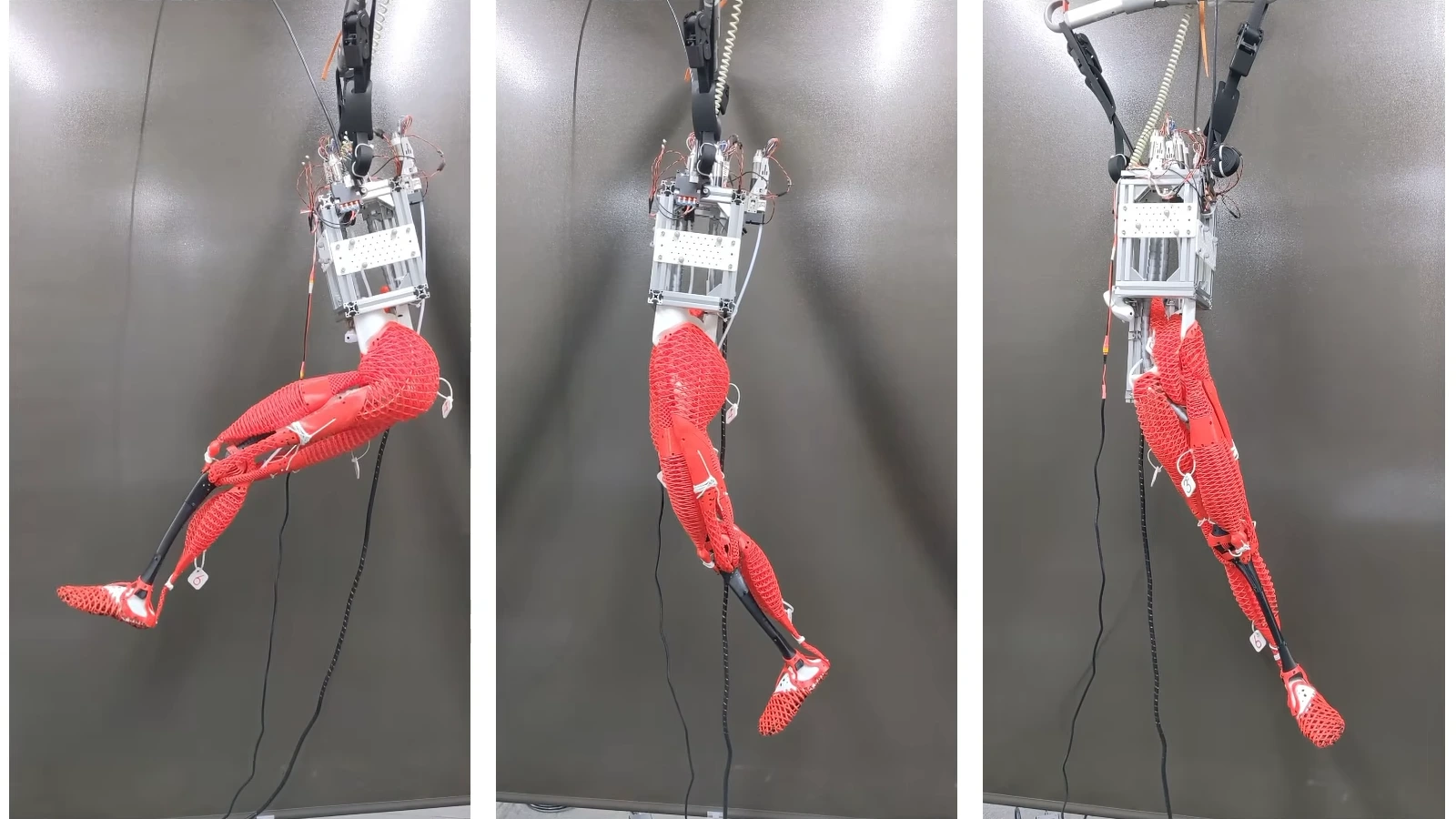
Researchers at the University of Tokyo have built a life-size robotic leg system whose muscle-like, tendon-like and ligament-like parts are all 3D-printed from a single flexible plastic, TPU. Shunnosuke Yoshimura, Kento Kawaharazuka and Kei Okada published the work in Advanced Intelligent Systems on 11 September.
The team changes the printed geometry, including lattice density and strut thickness, so that each region behaves differently. One print can shift from a soft, muscle-like zone to a stiffer, tendon-like one. Patterned ligaments hold the hip, knee and ankle in place without bearings. Motors and pulleys sit on the pelvic frame and pull wires through Bowden cables, which keeps weight off the lower legs. The printed lattice does not contract by itself; it only deforms when the wires pull.
In the stepping tests, an external suspension carried part of the body weight and limited torso rotation, and the legs followed preset wire-length commands. Each muscle structure takes roughly 20 to 40 hours to print, and cable friction plus changing material behaviour under repeated loading make control harder.
Why it matters
The gain here is a shared way to design and make several kinds of compliant body parts that would normally each need custom work. It is not a walking robot. Independent walking and full-body integration are still ahead, and the researchers have not shown either. Watch for a version that balances without suspension, and for whether print times and control problems come down.